
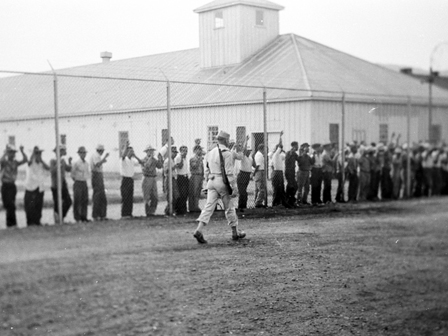
Within hours after the attack on Pearl Harbor, FBI and immigration agents went house to house arresting Issei men who were on lists of “suspects” compiled years earlier. The men taken away were, for the most part, community and business leaders, along with Japanese language teachers, newspaper editors, and Buddhist priests. Arrested German, Italian, and Japanese nationals received cursory hearings before being released or sent to an enemy alien internment camp. Run by the Department of Justice (DOJ) or the army, these internment camps were in a different system than the ten larger incarceration camps that held Issei and Nisei. If an Issei man was cleared after his hearing, he was “released” but not freed; rather, he was transferred to the other system of detention camps.
By the end of the war, the government had interned some 11,500 Germans and 2,700 Italians. The nearly 17,500 people of Japanese descent interned by the Department of Justice included more than 5,000 Nisei who renounced their U.S. citizenship and over 2,000 Japanese Latin Americans, who were deported to be used in prisoner of war exchanges. Because many Issei men were interned separately for years, their families suffered increased hardship and impaired family relationships. Some internees remained in DOJ camps until 18 months after the war’s end.
Major Enemy Alien Internment Camp
Crystal City, Texas
Fort Lincoln, North Dakota
Fort Missoula, Montana
Fort Stanton, New Mexico
Kenedy, Texas
Kooskia, Idaho
Lordsburg, New Mexico
Old Raton Ranch, New Mexico
Sand Island, Hawaii
Santa Fe, New Mexico
Seagoville, Texas

 Internees looking through a fence(1943)
 Department of Justice internment camp at Fort Missoula, Montana
Courtesy of the University of Washington Libraries
Excerpt from Densho Archive
I asked the doctor, "How come you're here?" He says, "They just came and got me." You could tell this guy is a leader, I sort of sensed it. Some Hawaiians, they said, "I don't know why they picked me up. I didn't do anything." And that's all I know. How they were selected is something that's beyond me. Except they knew certain people were president of this organization or president of, say, the Fukuoka kenjinkai, or this guy was the president of the Wakayama kenjinkai. But other than that, I don't know how they figured it out. There was this one guy who says, "What am I going to do when I get home?" "Where is home?" He says, "I want to go home to Santa Barbara. My wife is at home." I said, "Oh, you have a wife?" "Yeah, and two children." So, I said, "Why are you here?" "I don't know." He didn't know why he was there. Working and finding a place to stay, finding a place for his family--this is what I assume he was talking about. "God, how am I going to get myself all put back together again?"
Nisei taken to Santa Fe, New Mexico, Department of Justice internment camp after renouncing his U.S. citizenship