
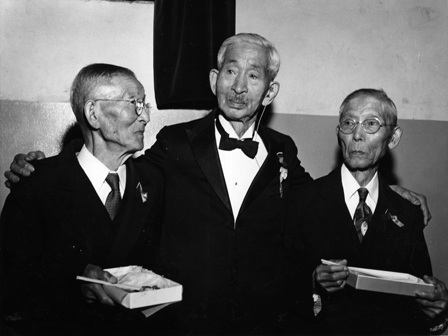
In the 1930s, intelligence agencies gathered information about foreign nationals who might endanger U.S. security in the event of war. The Federal Bureau of Investigation (FBI), the Navy, and private intelligence sources developed dossiers on aliens with connections they considered subversive. President Franklin Roosevelt also commissioned intelligence reports on the Issei and Nisei. All the credible reports the president received said that people of Japanese ancestry would not present a greater threat in the event of war than any other group. Investigators judged that most Issei were at least passively loyal to the United States and the Nisei strongly identified as Americans. Still, because of racial bias, the government deemed all Nikkei to be potentially dangerous, while it selectively scrutinized Germans and Italians. The FBI assembled lists categorized as A, B, and C, identifying Issei “suspects” who were to be arrested if war was declared “A” for leaders of cultural or aid-to-Japan organizations; “B” for slightly less suspicious Issei; and “C” for donors to Japanese associations, Japanese language teachers, and Buddhist clergy. In some cases, individuals with personal grievances provided the FBI with names of Issei rivals. While 20 Japanese agents were arrested during the war, none was of Japanese heritage. No Nikkei was convicted of espionage or sabotage before, during, or after World War II.

 Issei community leaders
 Seattle, Washington
Courtesy of Densho, the Uyeda Groves Family Collection
Excerpt from Densho Archive
My father got picked up. The FBI grabbed him, and took him to Missoula [Montana]. Then, in the interim, somebody came in and boxed up all his stuff and they stored it someplace. I mean, they just went and picked up certain people. I asked around the community several years ago. I said, "How the heck did they get names?" Some older Nisei I asked said, "Don't you know?" I say, "No. How'd they get the names?" He said, "Inu." I said, "What do you mean by that, inu? Inu is a dog." He says, "That's what they were." That's what they call stool pigeons -- inu. So there's somebody in the Japanese community that provided the names of people who were in organizations. There was Hinomarukai, which was a Japanese military group here for people that were in the Japanese Army. My dad was in the army-- he got drafted for a year or something back there. He was a cavalryman. And he belonged to a Japanese Chamber of Commerce. But he was not active. He just joined because I guess it was expected. And he joined Hinomarukai because it was expected. I think maybe he went to one meeting or something. But I guess he was a member because the FBI had all the information
Nisei from Seattle, avoided incarceration through railroad work outside exclusion zone