
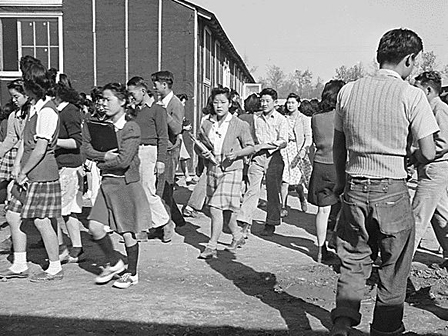
Because the median age of the Nisei in 1942 was 21, thousands of them were in college when ordered away from the West Coast. Some schools objected to the forced removal and tried to place students in colleges outside the military exclusion zone, but there was little time to make the necessary arrangements. Once in the incarceration camps, college students were stranded. The camps had elementary and high schools, but no access to higher education. Humanitarian and religious groups organized a program to sponsor Nisei students out of the camps to start or resume their college studies. The American Friends Service Committee (known as Quakers) in particular helped form the National Japanese American Student Relocation Council, which arranged for some 4,000 Nisei to attend some 600 colleges and universities outside the exclusion zone. The NJASRC helped Nisei navigate a sea of red tape required to exit camp; it persuaded colleges to accept Nikkei students despite the protests of the surrounding community; and it raised money to provide scholarships and living expenses. The Nisei students were seen as the vanguard representing all of their people, and consequently felt enormous pressure to perform well. In recent years, universities in California and other states have given honorary diplomas to the Nisei whose educations were interrupted by the incarceration.

 Incarceree high school students(1942)
Rohwer incarceration camp, Arkansas
Courtesy of the National Archives and Records Administration
Excerpt from Densho Archive
I went to Salt Lake City and I was supposed to go to the University of Utah. I had all my papers taken care of, and in order to leave camp, a requirement was that we find housing. Many of the families opened up their house and offered board and room. So, I was placed in a home, but those people had no intention of letting me go to school. They wanted a nursemaid and a housekeeper. I said, "Well I need to go register in school." They said, "My dear, you may go only in the evening. You need to work during the day for your board and room." When I went to the school they said, "Well, you're not going to be able to attend with this kind of schedule." I said, "Well, I want to go to school." And they said, "Well how's about business college?" So I went to LDS Business College. Then when my brother came to visit Salt Lake City during his furlough, the woman said, "I do not want any Jap soldiers coming to the house." I said, "My brother's in the U.S. Army!" She said, "No." Also she didn't want me to get any mail at her house, so I was getting my mail at my sister's. My sister had also left camp to go to work in a home. So when my brother came up, he said, "You're not going to stay there any longer." The woman said, "Well, I'm going to send her back to camp." And he said, "No, I'll take her back to the War Relocation Authority office.” My sister's family that she was staying with offered a space for me to stay until I found another place. Then I found another place and continued school.
left Minidoka, Idaho, incarceration camp to attend college; became a respected teacher and civil rights activist in Seattle